CASE STUDIES - 8 MINS
How GoFloaters Helped Acxhange Scale from 70 to 160 Seats Without Overcommitting on Office Costs
Acxhange did not need just another office.
They needed an office plan that could move at the same speed as the business.
As a growing IT services and engineering firm serving US clients, Acxhange wanted to expand in Chennai, but without making a large upfront cash-flow commitment before the growth had fully played out. That is where GoFloaters stepped in.
Instead of forcing a one-time, oversized lease, GoFloaters structured a managed office solution with WorkEZ Managed Offices that expanded in stages: an initial 70-seater office, a staggered pickup of 20 more seats in three months, a first right of refusal for another 30 seats, and then a further 40-seat expansion six months later. Every expansion happened on the same commercial terms that Acxhange originally signed.
That is what made this case work.
The office did not get ahead of the business.
It stayed aligned with it.
Key chapter:
- About the Client: Acxhange
- The Challenge: Growth Was Real, but Certainty Was Not
- Why a Fixed Office Commitment Would Have Been the Wrong Move
- The GoFloaters Solution: Staged Expansion With Downside Protection
- How the Office Scaled From 70 to 160 Seats
- Why This Mattered for Acxhange’s Business
- What Other Fast-Growing IT Services Firms Can Learn From This
- Conclusion
About the client: Acxhange
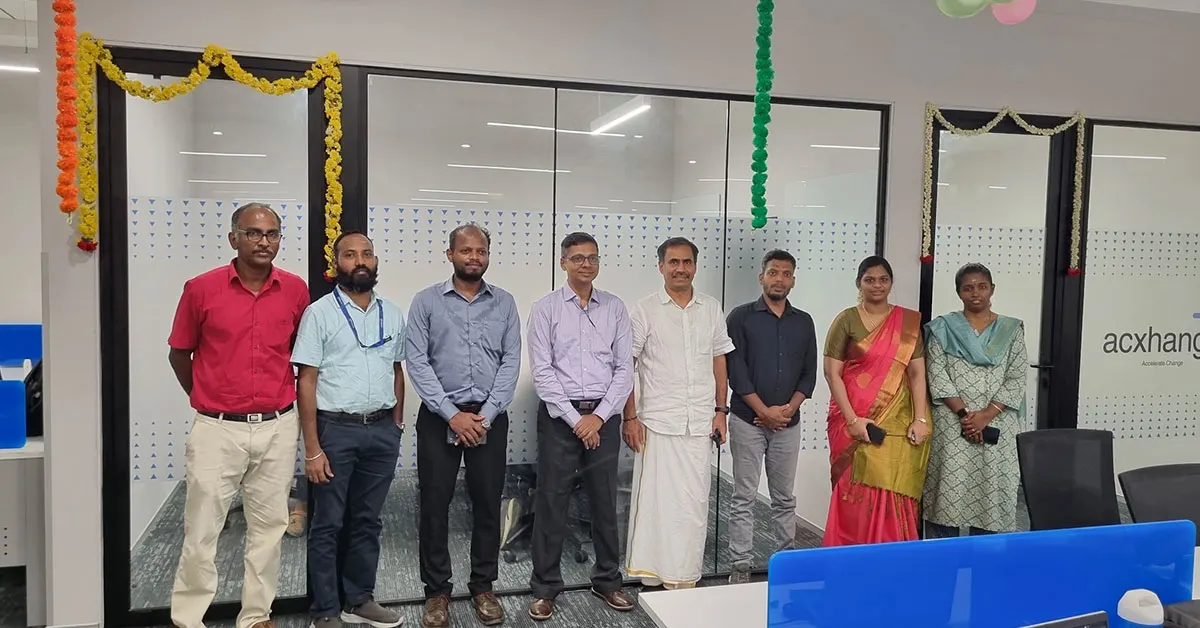
Acxhange is a strategic advisory and engineering firm with offices in Phoenix, Arizona and Chennai, India. The company describes itself as an engineering and execution focused business that helps clients accelerate transformation through strategy, engineering and innovation.
Its positioning is clear.
This is not a generic services company.
Acxhange works at the intersection of technology, execution and business transformation, with a strong focus on banking, financial services, insurance and digital engineering. Its public material also shows a clear push into AI-led solutions, including GenAI and document-processing workflows built for the insurance industry.
That matters in this case study because Acxhange was not just adding headcount for the sake of it.
It was scaling a client-facing delivery organisation with US exposure, global operating realities and the usual discipline that comes with revenue-linked hiring.
The challenge: growth was real, but certainty was not
Acxhange’s Chennai team was growing fast.
They moved from 70 to 160 people within a year.
But fast growth does not always mean you should take a large office upfront.
In fact, for many IT services firms, that is exactly when the wrong office decision gets made.
Acxhange had clients in the US. That meant the company wanted to stay conservative on cash flows rather than lock itself into a large, front-loaded commitment too early.
The business needed room to grow.
It also needed commercial caution.
Those two needs often pull in opposite directions.
A traditional lease or a rigid managed office setup would have pushed Acxhange into one of two bad outcomes:
commit too much too early and carry underused cost,
or take too little space and end up disrupting the team every time growth picked up.
Neither option was attractive.
The company needed a better third path.
Why a fixed office commitment would have been the wrong move
This is the part many workspace searches get wrong.
Companies assume the safest move is to sign for the office they might need twelve months from now.
But when revenue, hiring and client ramps are still unfolding, that is not safety.
That is speculation with rent attached.
For Acxhange, the smarter question was not:
How big an office do we want eventually?
It was:
How do we match office capacity to business reality as it unfolds?
That required three things:
a credible starting footprint,
pre-negotiated room to grow,
and commercial continuity so every later expansion did not reopen the deal from scratch.
That is where GoFloaters came in.
The GoFloaters solution: staged expansion with downside protection
GoFloaters worked with WorkEZ Managed Offices to build a phased workspace plan around Acxhange’s actual growth curve, not a forecast deck.
The structure was simple, but powerful.
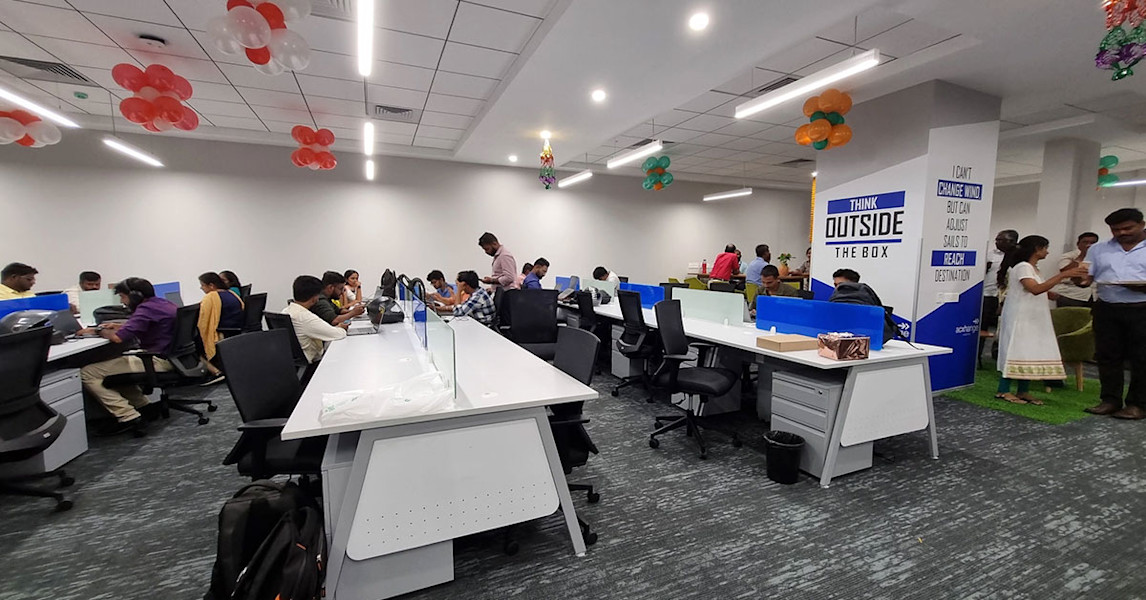
Acxhange started with a 70-seater office.
At the same time, GoFloaters structured:
a staggered pickup of another 20 seats after three months,
a first right of refusal (FRR) for an additional 30 seats,
and enough flexibility in the arrangement for further expansion without forcing the company into a fresh commercial reset.
That FRR point is important.
A lot of growing companies are told they can "expand later," but without any real protection on inventory. In practice, that often means the extra capacity disappears, the team gets split, or the economics worsen right when the client needs more space.
Here, the expansion path was built into the structure from day one.
So Acxhange was not gambling on future availability.
It had a real runway.
How the office scaled from 70 to 160 seats
The best part of this case is that the expansion logic did not stay theoretical.
It got used.
First, Acxhange moved into the initial 70-seater setup.
Then, within three months, it picked up the additional 20 seats that had been planned into the staggered growth structure
Within five months, the company also exercised the FRR-backed 30-seat expansion.
Then, six months later, it moved ahead with a further 40-seat addition.
That is how the office scaled in lockstep with the business.
Not through one oversized gamble.
Through a sequence of controlled decisions.
Just as importantly, all of these additions happened on the same terms Acxhange originally signed up for.
That is where the real business value sits.
Because expansion is only truly flexible if the commercial logic holds when the team grows.
If every extra block of seats triggers a new round of negotiation, repricing and uncertainty, the client is not getting flexibility.
They are just getting delay dressed up as optionality.
Acxhange avoided that.
Why this mattered for Acxhange’s business
This office strategy solved more than a seating problem.
It solved a capital-allocation problem.
For a fast-growing IT services company, office cost is not just a facilities question. It is tied directly to hiring confidence, delivery planning and cash-flow discipline.
By aligning workspace expansion to revenue visibility and actual team growth, Acxhange got a few critical advantages.
1. It protected cash flow early
The company did not have to commit to a 160-seat footprint before the business had fully reached that scale.
That matters even more when serving overseas clients, where hiring ramps can move quickly but conservatism on commitments still matters.
2. It reduced operational disruption
Because the expansion path was planned upfront, Acxhange did not have to restart the market search every time the team grew.
No scrambling.
No patchwork fixes.
No fragmented seating strategy.
3. It preserved commercial clarity
Keeping the same terms across later seat additions meant the business could scale without getting penalised for its own success.
That is a bigger differentiator than it sounds.
4. It gave leadership room to stay conservative without becoming slow
This is the real win.
The company did not have to choose between caution and growth.
It got both.
What other fast-growing IT services firms can learn from this
A lot of growing services companies still treat office planning as a one-time real estate event.
It is usually not.
It is a capacity-planning exercise.
If your revenue visibility is staged, your team growth is staged, and your client demand is staged, then your office should probably be staged too.
That does not mean choosing temporary or low-quality space.
It means choosing a structure that leaves room for the business to become more certain before the fixed costs do.
For companies serving global clients, this matters even more.
Because the biggest office mistake is often not paying too much rent.
It is committing too early, then spending the next year trying to justify the commitment.
Acxhange’s case shows a better model:
start with what the business can use now,
lock in a real expansion path,
protect the economics,
and grow into the footprint instead of betting on it upfront.
Quick answers
What problem did GoFloaters solve for Acxhange?
GoFloaters helped Acxhange avoid a large upfront office commitment by creating a staged managed-office expansion plan that tracked actual business growth rather than forecasted headcount alone.
Why was flexibility so important in this case?
Acxhange was growing quickly, but as an IT services company with US clients, it wanted to stay conservative on cash flows. The office strategy had to support expansion without forcing the company into premature fixed commitments.
What made the solution work?
Three things: a right-sized starting office, pre-negotiated expansion capacity, and continuity of commercial terms across every later seat addition.
Who delivered the workspace?
GoFloaters structured the solution in partnership with WorkEZ Managed Offices.
Conclusion
This case was not about finding Acxhange a bigger office.
It was about building an office strategy that respected how the business was actually growing.
Acxhange scaled from 70 to 160 people within a year.
GoFloaters made sure the workspace could scale with it, one commercial step at a time.
The result was not just more seats.
It was a better match between office cost, business confidence and growth timing.
That is what good workspace strategy looks like.
Not just finding a space.
Finding a structure the business can grow into.